Ashe County Dog Registration Information
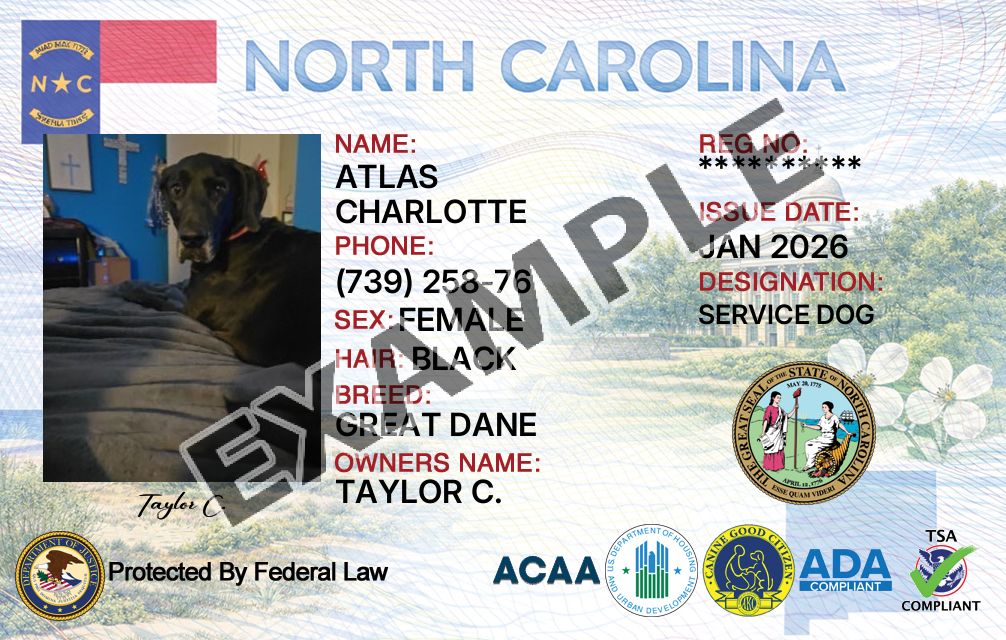
Service Dogs and Emotional Support Animals in Ashe, North Carolina
If you’re searching for where do I register my dog in Ashe County, North Carolina for my service dog or emotional support dog, it helps to separate three different concepts: a dog license in Ashe County, North Carolina (when required locally), rabies vaccination compliance (a public health requirement), and a dog’s service dog or emotional support animal (ESA) status (which is based on disability-related laws and housing rules—not a paid “registration” website).
In Ashe County, the most practical “registration” most residents need is handled through local government—typically the agency that manages animal control and rabies enforcement. This page explains where to register a dog in Ashe County, North Carolina, what documents you may need, and what does (and does not) change if your dog is a service dog or an ESA.
Where to Register or License Your Dog in Ashe County, North Carolina
Because pet licensing and enforcement are usually handled locally, these are example official offices within Ashe County, North Carolina that residents commonly contact about rabies tags, animal control, and other animal-related requirements. If you live inside a town’s limits, you may also have municipal rules; when in doubt, start with county animal control.
Ashe County Animal Control
- Address
- 767 Fred Pugh Rd
- City/State/ZIP
- Crumpler, NC 28617
- Phone
- (336) 982-4060
- animalcontrol@ashecountygov.com
- Office hours
- By appointment only (per county notice)
Appalachian District Health Department (Ashe County)
- Address
- 413 McConnell St
- City/State/ZIP
- Jefferson, NC 28640
- Phone
- (336) 246-9449
- Not listed on the referenced directory
Ashe County Register of Deeds
- Address
- 150 Government Circle, Suite 2300
- City/State/ZIP
- Jefferson, NC 28640
- Phone
- (336) 846-5580
- registerofdeeds@ashecountygov.com
- Office hours
- Mon–Fri, 8:00 a.m.–5:00 p.m.
Overview of Dog Licensing in Ashe County, North Carolina
Is there a countywide dog license?
Across North Carolina, dog licensing and related rules are often set and enforced at the local level (county or town). That means the answer to “do I need a dog license in Ashe County, North Carolina?” can depend on:
- Where you live (unincorporated county areas vs. within a town’s limits)
- Current county ordinances and enforcement practices
- Whether local rules link licensing/tags to rabies vaccination records
For the most accurate, current instructions on where to register a dog in Ashe County, North Carolina, contact Ashe County Animal Control first. They are the county office most directly responsible for animal-related enforcement and shelter operations, and they can tell you exactly what Ashe County requires today.
Rabies vaccination is the baseline requirement
Even when a “license” label varies by locality, rabies vaccination compliance is the standard baseline for owned dogs. Most local processes—such as obtaining a tag, proving compliance, or resolving an animal control inquiry—start with showing proof that your dog is current on rabies vaccination.
Service dogs and ESAs: licensing is separate
A common misunderstanding is that a service dog or ESA needs a special “registration” with the county. In reality, any local licensing requirement applies based on residency and local ordinance—not whether the dog is a service animal or emotional support animal. What changes is how the dog is treated under public access rules (service dogs) and housing accommodations (ESAs).
How Dog Licensing Works Locally in Ashe County, North Carolina
Step-by-step: how to “register” locally (the practical approach)
If you want the clearest path for animal control dog license Ashe County, North Carolina questions—or if you simply want to ensure you’re compliant—use this local-first checklist:
- Confirm rabies vaccination is current. Ask your veterinarian for a rabies vaccination certificate/receipt and keep a copy (paper or digital).
-
Call Ashe County Animal Control and ask:
- Whether Ashe County requires a dog license, permit, or local tag
- Whether the county issues or recognizes a rabies tag, and how replacement tags work
- What fees (if any) apply and what payment methods are accepted
- How service dogs are handled for county records (if applicable)
- Ask about your address location. If you live inside a town’s limits, ask whether the town has additional requirements beyond the county’s.
- Keep your documentation accessible. This is especially helpful if you travel, rent housing, or need to reclaim a lost dog.
Why local offices matter (and online “registries” don’t)
Local licensing or compliance systems exist for public safety and reunification. Animal control and public health workflows frequently rely on:
- Rabies vaccination verification
- Owner contact information
- Local ordinances on dogs running at large, nuisance behavior, bites, and quarantine rules
By contrast, third-party “registration” sites usually do not change your legal rights, and they typically are not part of official local enforcement records. If your goal is compliance in Ashe County, stick with county and state public health resources.
Rabies enforcement and what happens after a bite or exposure
If a bite incident or rabies exposure concern occurs, animal control/public health protocols may require proof of current vaccination, quarantine instructions, and owner identification. Keeping rabies documentation current helps avoid delays and complications.
Service Dog Laws in Ashe County, North Carolina
What makes a dog a “service dog” (and what does not)
A service dog is generally a dog that is individually trained to do work or perform tasks for a person with a disability. The key is trained tasks that relate to the disability (for example: guiding, alerting, retrieving items, interrupting harmful behaviors, or providing mobility assistance).
A service dog is not defined by:
- A purchased ID card
- An online certificate
- A vest or “service animal” patch
- Being “registered” with a private company
Do service dogs need a special county registration in Ashe County?
In most cases, your service dog’s legal status is not created by county paperwork. If Ashe County has a local licensing requirement, your service dog typically follows the same local compliance steps as any other dog (especially rabies vaccination proof).
If you’re asking where do I register my dog in Ashe County, North Carolina for my service dog, the safest interpretation is: “Where do I ensure local compliance and records?”—and the answer starts with Ashe County Animal Control and proof of rabies vaccination.
Public access basics (what businesses can ask)
In many public settings, staff are limited in what they can ask about a service dog. Practically, you generally do not need to show a registration document, but you should be prepared to describe that the dog is a service animal and what work/tasks it is trained to perform (without disclosing private medical details).
Emotional Support Animal Rules in Ashe County, North Carolina
What an emotional support animal (ESA) is
An emotional support animal provides comfort by its presence and may be part of a person’s treatment plan. Unlike service dogs, ESAs are generally not required to be trained to perform specific disability-related tasks.
ESAs vs. service dogs: key differences
| Topic | Service Dog | Emotional Support Animal (ESA) |
|---|---|---|
| Primary legal concept | Disability assistance through trained tasks | Support/comfort as part of a disability-related need (commonly in housing) |
| Training requirement | Yes (trained to perform work/tasks) | No specific task-training requirement |
| Public access to stores/restaurants | Commonly allowed when appropriately behaved | Not the same public-access rights as service dogs |
| Local dog license / rabies compliance | Still required if locally applicable | Still required if locally applicable |
Do I need to “register” my ESA with Ashe County?
Generally, no special county “ESA registration” is required to have an emotional support animal. If you’re trying to meet a landlord’s documentation requirements, the usual route is a letter from a qualified healthcare provider supporting the need for an ESA as a reasonable accommodation. That is separate from any local requirements for a dog license in Ashe County, North Carolina or rabies vaccination proof.
If you’re unsure what your landlord can require, focus on (1) keeping rabies vaccination up to date, (2) maintaining responsible control of the dog, and (3) documenting your accommodation request through appropriate medical channels rather than paying an online “certification” vendor.
Frequently Asked Questions
Register A Dog In Other North Carolina Counties
Select your county below to get started with your dog’s ID card. Requirements and license designs may vary by county, so choose your location to see the correct options and complete your pup’s registration.
- Alamance County Dog Registration
- Alexander County Dog Registration
- Alleghany County Dog Registration
- Anson County Dog Registration
- Avery County Dog Registration
- Beaufort County Dog Registration
- Bertie County Dog Registration
- Bladen County Dog Registration
- Brunswick County Dog Registration
- Buncombe County Dog Registration
- Burke County Dog Registration
- Cabarrus County Dog Registration
- Caldwell County Dog Registration
- Camden County Dog Registration
- Carteret County Dog Registration
- Caswell County Dog Registration
- Catawba County Dog Registration
- Chatham County Dog Registration
- Cherokee County Dog Registration
- Chowan County Dog Registration
- Clay County Dog Registration
- Cleveland County Dog Registration
- Columbus County Dog Registration
- Craven County Dog Registration
- Cumberland County Dog Registration
- Currituck County Dog Registration
- Dare County Dog Registration
- Davidson County Dog Registration
- Davie County Dog Registration
- Duplin County Dog Registration
- Edgecombe County Dog Registration
- Forsyth County Dog Registration
- Franklin County Dog Registration
- Gaston County Dog Registration
- Gates County Dog Registration
- Graham County Dog Registration
- Granville County Dog Registration
- Greene County Dog Registration
- Guilford County Dog Registration
- Halifax County Dog Registration
- Harnett County Dog Registration
- Haywood County Dog Registration
- Henderson County Dog Registration
- Hertford County Dog Registration
- Hoke County Dog Registration
- Hyde County Dog Registration
- Iredell County Dog Registration
- Jackson County Dog Registration
- Johnston County Dog Registration
- Jones County Dog Registration
- Lee County Dog Registration
- Lenoir County Dog Registration
- Lincoln County Dog Registration
- Macon County Dog Registration
- Madison County Dog Registration
- Martin County Dog Registration
- McDowell County Dog Registration
- Mecklenburg County Dog Registration
- Mitchell County Dog Registration
- Montgomery County Dog Registration
- Moore County Dog Registration
- Nash County Dog Registration
- New Hanover County Dog Registration
- Northampton County Dog Registration
- Onslow County Dog Registration
- Orange County Dog Registration
- Pamlico County Dog Registration
- Pasquotank County Dog Registration
- Pender County Dog Registration
- Perquimans County Dog Registration
- Person County Dog Registration
- Pitt County Dog Registration
- Polk County Dog Registration
- Randolph County Dog Registration
- Richmond County Dog Registration
- Robeson County Dog Registration
- Rockingham County Dog Registration
- Rowan County Dog Registration
- Rutherford County Dog Registration
- Sampson County Dog Registration
- Scotland County Dog Registration
- Stanly County Dog Registration
- Stokes County Dog Registration
- Surry County Dog Registration
- Swain County Dog Registration
- Transylvania County Dog Registration
- Tyrrell County Dog Registration
- Union County Dog Registration
- Vance County Dog Registration
- Wake County Dog Registration
- Warren County Dog Registration
- Washington County Dog Registration
- Watauga County Dog Registration
- Wayne County Dog Registration
- Wilkes County Dog Registration
- Wilson County Dog Registration
- Yadkin County Dog Registration
- Yancey County Dog Registration